AI in Sterile Processing Is Proving Its Value by Acting as a Co-Pilot, Not a Replacement
Sterile processing departments are dealing with persistent operational pressures. Surgical case volumes are rising, instruments are more complex, and staffing shortages remain across many health systems. Accuracy and documentation requirements continue to tighten, leaving little room for error. In busy hospitals, sterile processing teams may handle 10,000 to 30,000 surgical instruments per day, with performance tightly linked to patient risk given the persistent burden of surgical site infections in inpatient care. These conditions are shaping how hospitals evaluate AI in sterile processing as a practical way to support frontline teams without adding disruption or risk.
As health systems reassess where technology can provide real operational support, what does effective adoption look like inside day-to-day SPD workflows?
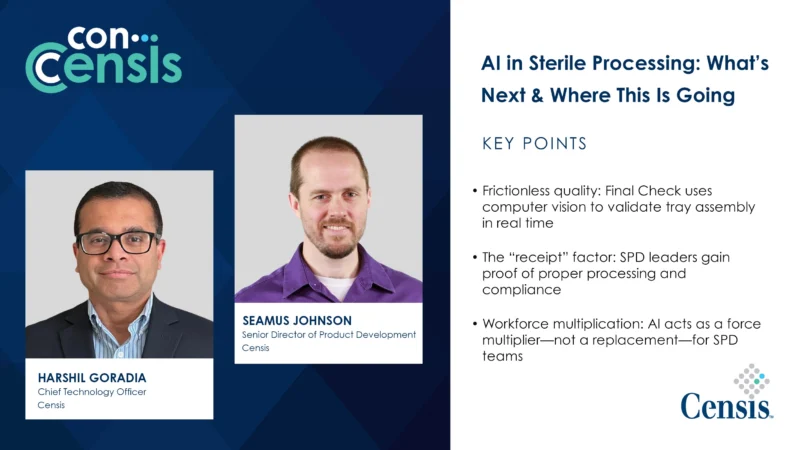
In this episode of ConCensis by Censis Technologies, host Daniel Litwin is joined by Censis Chief Technology Officer Harshil Goradia and Senior Director of Product Development Seamus Johnson for a grounded discussion on how AI is being applied inside sterile processing today. The conversation centers on where AI delivers measurable value in SPD workflows, why some use cases succeed while others fall short, and how technology can reinforce technician performance without disrupting established processes.
Key points :
-
AI is most valuable where traditional software breaks down: Rule-based tools struggle with visual, variable, real-world conditions such as lighting, positioning, and tray variability. AI in sterile processing, particularly computer vision, can interpret this complexity without hard-coding every possible scenario.
-
Consistency is the core challenge across SPD workflows: Decontamination, assembly, and sterilization remain the highest-risk steps. Volume growth, case complexity, and staffing strain increase the likelihood of errors, making consistency a primary focus for AI in sterile processing initiatives.
-
Final check use cases can have an outsized impact: In customer environments referenced in the episode, missing integrators dropped from dozens per month to zero after implementation. These results show how targeted AI in sterile processing applications can improve accuracy while strengthening documentation and accountability.
Harshil Goradia is a technology executive specializing in AI, SaaS, and large-scale digital transformation across healthcare and enterprise software. As CTO and VP of IT at Censis Technologies, he leads global engineering and AI initiatives that drive product innovation, operational efficiency, and revenue growth. His career spans senior leadership roles at Fortive, Arrow Electronics, and Oracle, delivering high-impact technology platforms and scalable modernization programs.
Seamus Johnson is a senior software developer with more than two decades of experience building technology solutions for the healthcare industry. At Censis Technologies, he leads application development across software architecture, cloud systems, databases, and security, with a focus on supporting hospital and sterile processing workflows. His background includes enterprise software development roles at Censis and Northrop Grumman, grounded in a technical foundation in physics and agile engineering practices.