Censis’ Final Check Uses Computer Vision to Eliminate Tray Errors Before They Reach the OR
Artificial intelligence used to live in strategy decks and conference keynotes—but now it’s showing up in a very different place: right on the assembly tables where SPD technicians build trays for the next case. And it’s arriving at a time when the pressure on sterile processing has never been higher. As surgical volumes climb and staffing shortages continue to strain hospital teams, SPDs are being asked to move faster while making zero mistakes. Even a single missing instrument can mean tray rework, case delays, and tension between departments. That’s why AI-powered computer vision is gaining attention: not as a futuristic replacement for technicians, but as a second set of eyes built directly into the workflow.
Can AI meaningfully reduce tray errors and compliance risk in SPDs—without disrupting workflows or replacing the human expertise at the center of sterile processing?
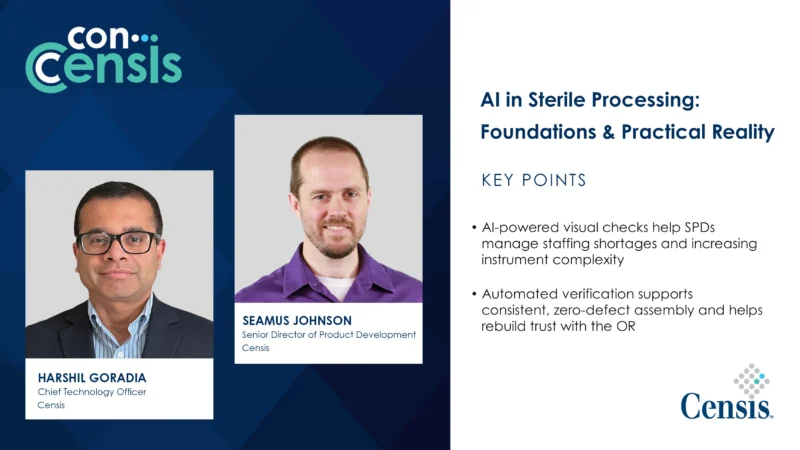
Welcome to ConCensis. Continuing from a previous episode in this two-part conversation, host Daniel Litwin rejoins Censis Chief Technology Officer Harshil Goradia and Senior Director of Product Development Seamus Johnson to explore the future of AI in sterile processing. The episode centers on Censis Technologies’ AI-powered sterile processing solution, Assembly Copilot: Final Check, a computer vision tool that detects missing chemical integrators before trays leave the assembly area. Together, the group discusses real-world results from early adopters, how the tool integrates seamlessly into existing workflows, and what the next three to five years of AI innovation in SPDs could look like.
What you’ll learn…
-
How Final Check drove missing integrator occurrences down to zero by flagging omissions in real time—stopping trays before they left assembly and required rework or delayed a case.
-
Why embedded computer vision and real-time alerts strengthen compliance without adding tool fatigue, integrating directly into technician workflows instead of forcing teams to adopt separate systems or change standard work processes.
-
What responsible AI adoption looks like in sterile processing, including human-in-the-loop oversight, transparent governance practices, and a phased approach that builds trust with technicians and hospital leadership.
Harshil Goradia serves as the Chief Technology Officer and VP of IT at Censis Technologies, where he leads global engineering, AI, innovation, and digital transformation initiatives across commercial and government healthcare businesses. He has a proven track record of launching revenue-generating AI products, building AI-native data platforms, modernizing cloud and IT infrastructure, and driving measurable growth, efficiency gains, and cybersecurity excellence within large enterprise environments, including Fortive and Fortune 100 organizations. Previously, he led AI Centers of Excellence and large-scale cloud, ERP, and digital transformation programs across the U.S., Europe, and Asia, delivering multi-million-dollar impact and scaling high-performing global technology teams.
Seamus Johnson is a Senior Software Developer at Censis Technologies with more than two decades of experience building and scaling healthcare technology solutions. He specializes in software architecture, cloud systems, database design, cybersecurity, and full-stack development using technologies such as C#, Angular, and TypeScript. With a background in physics from Tennessee Technological University and prior experience at Northrop Grumman, Johnson brings deep technical expertise and long-standing industry experience to the development of secure, high-performance applications for sterile processing and hospital environments.
Article written by MarketScale.