ConCensis – Censis
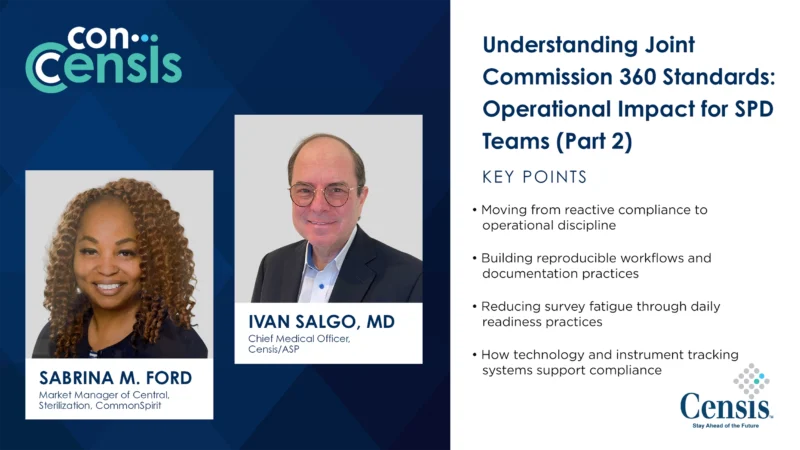
Healthcare teams today are feeling the pressure to move beyond last-minute compliance and instead build processes that work consistently every day. That shift is especially clear in sterile processing departments (SPDs), where the Joint Commission 360 model is redefining what “survey readiness” really means. With patient safety directly tied to instrument quality—and studies consistently…
Latest
Articles Healthcare
Understanding Joint Commission 360 Standards: What They Mean for SPD Teams (Part 1)
For a long time, compliance in healthcare was tied to the survey cycle. Now, that model is shifting. With the introduction of Joint Commission 360, organizations are being asked to demonstrate continuous performance—not just preparedness. As patient safety comes under increasing scrutiny, The Joint Commission is moving toward an approach built on real-time data, traceability,…
Articles Healthcare
Censis’ Final Check Uses Computer Vision to Eliminate Tray Errors Before They Reach the OR
Artificial intelligence used to live in strategy decks and conference keynotes—but now it’s showing up in a very different place: right on the assembly tables where SPD technicians build trays for the next case. And it’s arriving at a time when the pressure on sterile processing has never been higher. As surgical volumes climb and…
Censis
AI in Sterile Processing Is Proving Its Value by Acting as a Co-Pilot, Not a Replacement
Sterile processing departments are dealing with persistent operational pressures. Surgical case volumes are rising, instruments are more complex, and staffing shortages remain across many health systems. Accuracy and documentation requirements continue to tighten, leaving little room for error. In busy hospitals, sterile processing teams may handle 10,000 to 30,000 surgical instruments per day, with…
Articles Healthcare
Survey Ready Every Day: Why It’s Not Just a Once-a-Year Activity
Unannounced surveys are no longer the exception in healthcare—they’re the norm. Accrediting bodies increasingly expect sterile processing departments (SPDs) to demonstrate consistent compliance, real-time documentation, and reliable adherence to manufacturers’ instructions for use on any given day, not just during audit season. Joint Commission survey data continue to show that high-level disinfection and sterilization practices…
Articles Healthcare
Getting SPD Teams to the Table: Why Sterile Processing Deserves a Central Role in Surgical Planning and Operations
Sterile Processing Departments (SPDs) remain the backbone of safe surgical care, yet across the country, they’re still routinely left out of early decision-making around products, construction, staffing, and case planning. As hospitals juggle tighter margins, higher patient acuity, and growing procedural demands, the consequences of excluding SPD voices become unmistakably real—showing up in daily…
Articles Healthcare
The Silent Foundation of Patient Safety: Why Water Quality Matters in Sterile Processing
In healthcare, patient safety and operational efficiency often depend on invisible systems working perfectly in the background. One of those systems—water quality—has quietly become a defining factor in sterile processing success. With new standards such as AAMI ST108 setting stricter expectations, hospitals, and SPDs (Sterile Processing Departments) are rethinking how they monitor, manage, and measure…
Latest

Building Beauty for Real Women: Why Brands Must Focus on Longevity, Not Hype
Walk into any beauty aisle—or scroll through your feed for five minutes—and it’s clear the industry is obsessed with what’s new. New formulas, new trends, new “rules.” But for many women, especially those who’ve been using makeup for decades, the question isn’t what’s new—it’s what actually works. And increasingly, the answer isn’t coming from the…

Fixing the Physician Experience: Why Advocacy Is Healthcare’s Next Frontier
Physician burnout has become a defining challenge in healthcare, with research showing that a substantial portion of clinicians—anywhere from roughly a quarter to over half—experience emotional exhaustion, driven more by systemic pressures like administrative burden and reduced autonomy than by individual resilience alone. As healthcare systems face growing staffing shortages and rising patient demand, the…

From Starting Over In A New Country To Reaching The C-Suite: A CFO’s Career Comeback
Global mobility is reshaping the modern workforce, with millions of professionals relocating each year in pursuit of opportunity, stability, or growth. Yet behind the headlines of talent migration lies a quieter, more difficult truth: restarting a career from scratch—even after years of success—is far more common than people expect. In fact, many skilled immigrants…
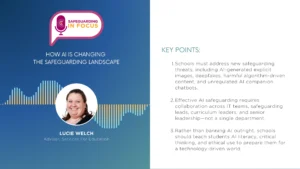
How AI is Changing the Safeguarding Landscape
This episode of “Safeguarding in Focus,” hosted by Sam Eustace, features Lucie Welch, an expert in primary education and safeguarding from Services for Education. The discussion centers on how AI is transforming the safeguarding landscape in schools, exploring both the risks and opportunities presented by this rapidly evolving technology. Key takeaways: Schools must address…