ConCensis – Censis
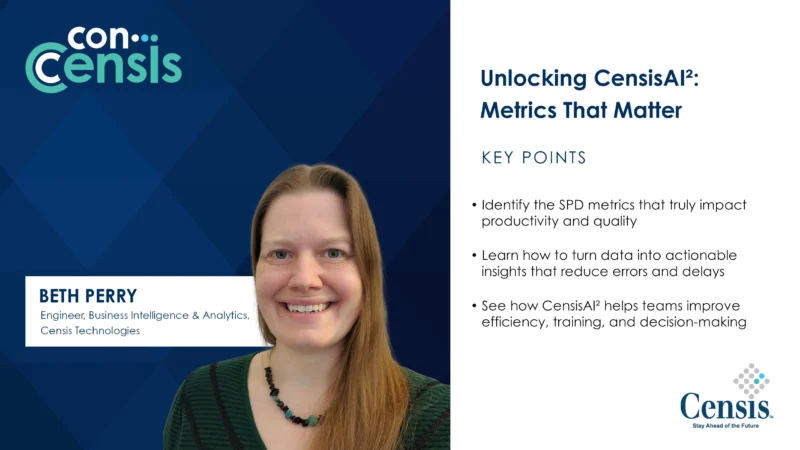
Sterile processing departments are swimming in data, from workflow automation and supply data to patient outcome and quality metrics. But the real challenge is not collecting more information; it is knowing which metrics actually improve SPD performance, technician education, OR readiness and patient safety. For Censis, a leader in surgical asset management, the focus…
Latest
Articles Healthcare
Understanding Joint Commission 360 Standards: What They Mean for SPD Teams (Part 2)
Healthcare teams today are feeling the pressure to move beyond last-minute compliance and instead build processes that work consistently every day. That shift is especially clear in sterile processing departments (SPDs), where the Joint Commission 360 model is redefining what “survey readiness” really means. With patient safety directly tied to instrument quality—and studies consistently…
Articles Healthcare
Understanding Joint Commission 360 Standards: What They Mean for SPD Teams (Part 1)
For a long time, compliance in healthcare was tied to the survey cycle. Now, that model is shifting. With the introduction of Joint Commission 360, organizations are being asked to demonstrate continuous performance—not just preparedness. As patient safety comes under increasing scrutiny, The Joint Commission is moving toward an approach built on real-time data, traceability,…
Articles Healthcare
Censis’ Final Check Uses Computer Vision to Eliminate Tray Errors Before They Reach the OR
Artificial intelligence used to live in strategy decks and conference keynotes—but now it’s showing up in a very different place: right on the assembly tables where SPD technicians build trays for the next case. And it’s arriving at a time when the pressure on sterile processing has never been higher. As surgical volumes climb and…
Censis
AI in Sterile Processing Is Proving Its Value by Acting as a Co-Pilot, Not a Replacement
Sterile processing departments are dealing with persistent operational pressures. Surgical case volumes are rising, instruments are more complex, and staffing shortages remain across many health systems. Accuracy and documentation requirements continue to tighten, leaving little room for error. In busy hospitals, sterile processing teams may handle 10,000 to 30,000 surgical instruments per day, with…
Articles Healthcare
Survey Ready Every Day: Why It’s Not Just a Once-a-Year Activity
Unannounced surveys are no longer the exception in healthcare—they’re the norm. Accrediting bodies increasingly expect sterile processing departments (SPDs) to demonstrate consistent compliance, real-time documentation, and reliable adherence to manufacturers’ instructions for use on any given day, not just during audit season. Joint Commission survey data continue to show that high-level disinfection and sterilization practices…
Articles Healthcare
Getting SPD Teams to the Table: Why Sterile Processing Deserves a Central Role in Surgical Planning and Operations
Sterile Processing Departments (SPDs) remain the backbone of safe surgical care, yet across the country, they’re still routinely left out of early decision-making around products, construction, staffing, and case planning. As hospitals juggle tighter margins, higher patient acuity, and growing procedural demands, the consequences of excluding SPD voices become unmistakably real—showing up in daily…
Latest

From Second Chances to Stronger Teams: Bradley Henderson on Structure, Culture, and Trades-Based Redemption
The trades have always demanded grit, but grit alone doesn’t build a strong workforce. People need structure, clear expectations, and a sense that their work is taking them somewhere. That’s especially true in HVAC and mechanical services, where employers are trying to hire, retain, and develop talent in a labor market that feels tighter and…

Creative Confidence and Moral Courage: The Leadership Traits Business Schools Should Be Betting On
What students need from higher education is becoming harder to pin down than it once was. As higher education faces mounting pressure—from student disengagement to the rapid rise of artificial intelligence—institutions are being forced to rethink not just what students learn, but who they become. New research and industry signals suggest that technical knowledge…

From the C-Suite to the Classroom: A Healthcare Leader’s Bet on the Next Generation
Healthcare isn’t short on strategy right now—it’s short on people, access, and experienced leadership where it matters most. In Texas alone, more rural hospitals have closed than in any other state over the past decade, leaving entire communities with limited access to care. At the same time, many health systems are realizing they haven’t…

The AI Health Score: Turning Hallucinations, Agents, and AI Risk Into Board-Ready Insight
As artificial intelligence moves deeper into enterprise operations, many organizations are discovering that the real challenge is not adoption, but control. Traditional software has always been predictable: the same input produces the same output, making it possible to audit systems at a fixed point in time. AI changes that equation. Jeff Carson, founder of…