Tidel Provides Secure Cash Automation for Walk to Bank Customers

At Tidel, we recognize that there are a number of retail franchise owners who elect to not utilize the services of third party cash-in-transit providers to transport their deposits to their bank.  This could be due to that fact that their store is in very close proximity to their local bank branch, where the owner or manager doesn’t mind transporting the deposits as part of his daily activity.  To the franchise owner, spending a few minutes away from the store and transporting money to the bank isn’t a significant burden.

But managing cash in a store goes far beyond transporting funds to the bank and making the deposit on time.

When franchise owners manage cash using older, manual methods, there are other risks and associated costs involved – including risk of theft and robberies, lack of cash visibility, spending time counting money, experiencing numerous “overs and shorts”, investigating discrepancies, preparing deposits, and managing the store’s change fund.   These costs can add up quickly, which can certainly put a dent on the retail store’s bottom line.

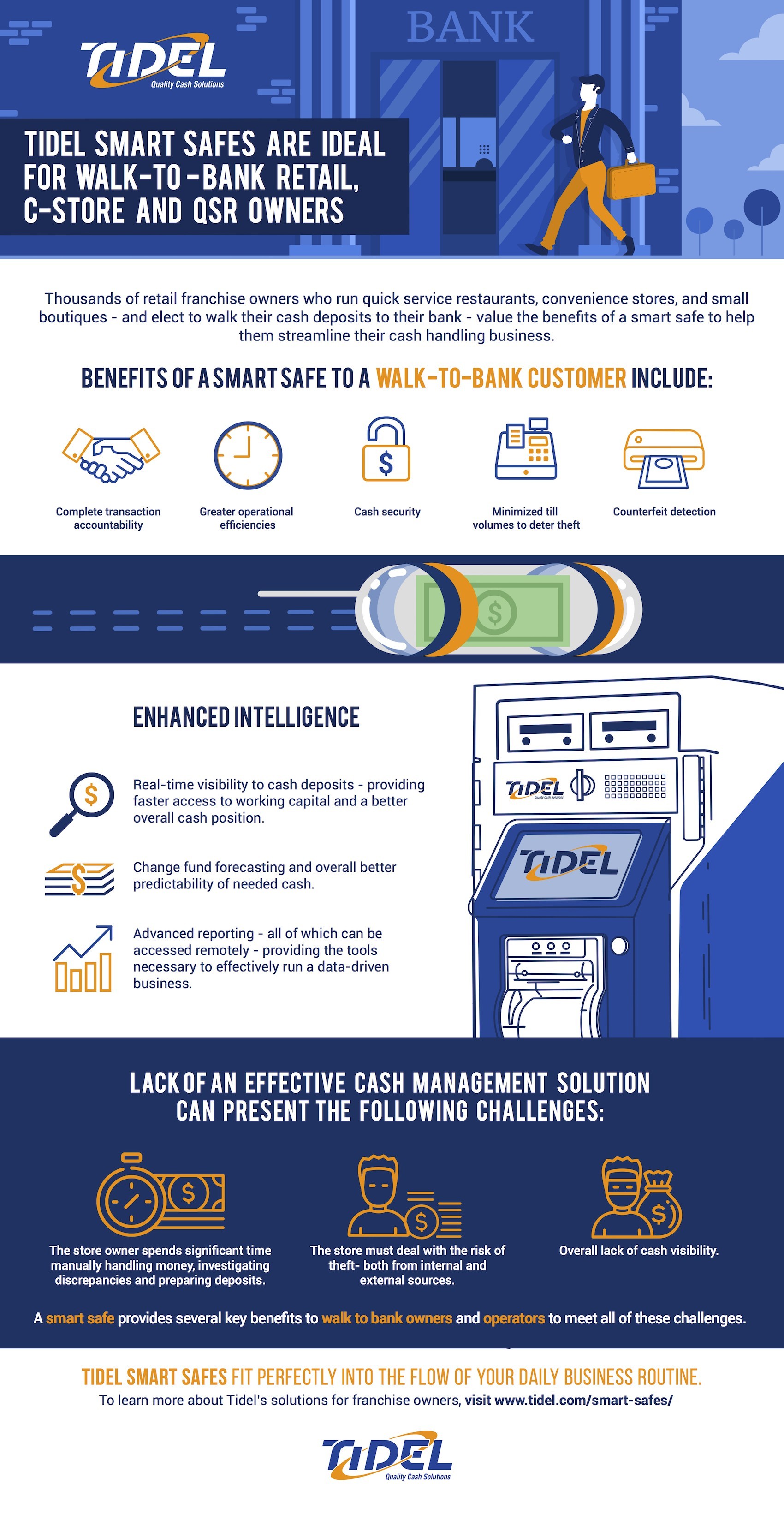
Tidel smart safes are designed to protect, automate, and streamline the cash management function for a wide spectrum of franchised stores – including quick serve restaurants, convenience stores, and others, enabling these organizations to increase efficiencies, promote accountability, reduce risks, and improve operating margins.

The accompanying infographic highlights how our solutions help relieve the costs and risks associated with manual cash handling – particularly for owners who remain proponents of self-transporting their deposits to their bank.

To learn more about our automated cash management solutions, visit www.tidel.com today.
TIDEL-Smart-safes-ideal

Read more at tidel.com

Follow us on social media for the latest updates in B2B!

Image

Latest

data center workforce
The Next Data Center Bottleneck Isn’t Power or Cooling — It’s People: The Data Center Workforce
February 8, 2026

With the rapid rise of AI workloads, data centers are being built with higher power density, stricter reliability expectations, and cooling technologies that are evolving faster than most teams can adapt. As a result, these facilities aren’t just getting bigger—they’re becoming harder to operate, harder to staff, and far less forgiving when something goes…

Read More
Telecom
Precision With Purpose: The Geospatial Advantage in Telecom Network Planning
February 7, 2026

Telecom networks are no longer planned or evaluated in isolation. As 5G, private LTE, fixed wireless, and mission-critical communications expand, operators are expected to deliver stronger coverage, higher reliability, and demonstrable performance—often while managing complex technologies and constrained resources. Regulators, customers, and public agencies are increasingly focused on outcomes that can be measured and…

Read More
future of public safety
Clarity Under Pressure: Technology, Trust, and the Future of Public Safety
February 7, 2026

When something goes wrong in a community—a major storm, a large-scale accident, a violent incident—there’s often a narrow window where clarity matters most. Leaders must make fast decisions, responders need to trust the information in front of them, and the systems supporting those choices have to work as intended. Public safety agencies now rely…

Read More
weather Intelligence
Clarity in the Storm: Weather Intelligence, GIS, and the Future of Operational Awareness
February 6, 2026

For many organizations today, the weather has shifted from an occasional disruption to a constant planning factor. Scientific assessments show that extreme weather events—including heatwaves, heavy rainfall, and wildfires—are occurring more frequently and with greater intensity, placing growing strain on infrastructure, utilities, and public services. As weather-related disruptions become more costly and harder to…

Read More