Amaryllis Was Founded on Demand and a Good Idea

Companies are like superheroes in that they all have an origin story, explaining how they started and began to build something meaningful. In this episode of the Software and Technology Podcast, host Tyler Kern sat down with Amaryllis Payment Solutions co-founders Ori Hay and Adi Ekshtain. They discuss their origin story and how the two recognized the demand for third-party aggregators in payment services that would revolutionize the industry.
Before co-founding Amaryllis with Ekshtain, Hay spent more than a decade working in credit card processing services and saw the coming wave of e-commerce transactions. “I recognized that this is where things are going to go,” he said.
When Ekshtain wanted to create a third-party payment processing partner for e-commerce, he turned to Hay, a noted developer, patent holder, and expert in FinTech.
“I thought it was a very smart idea and it came at the right time,” Ekshtain said.
The two partnered to build a dot net software for payments, the first commercially-viable mobile face-to-face payment solution.
 “Back then with Microsoft, there was nothing to build real infrastructure on,” Hay said. “Since Adi is the technology guy, he came to me saying there’s a new thing called dot net.”
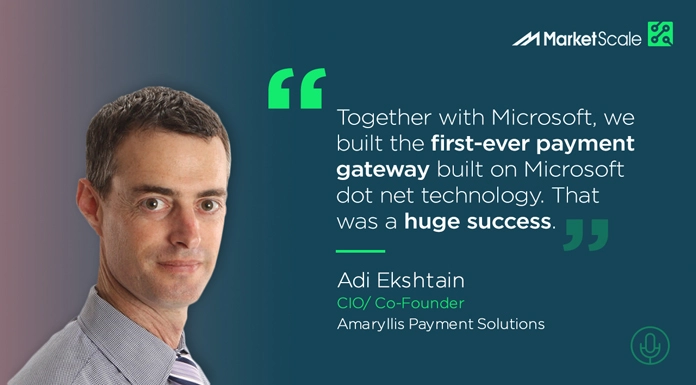
Ekshtain continued, “We struck a partnership with the Microsoft technology center. Together with them, we built the first-ever payment gateway built on Microsoft dot net technology. That proved to us we could build an economically-viable software, and it allowed Microsoft to have a case study of a financial system that is mission-critical.”
In this episode, Ekshtain and Hay also discussed the significance of the platform’s flexibility, the uniqueness of the payment solution, and how competition has followed their lead.
For the latest news, videos, and podcasts in the Software & Electronics Industry, be sure to subscribe to our industry publication.
Follow us on social media for the latest updates in B2B!
Twitter – @TechMKSL
Facebook – facebook.com/marketscale
LinkedIn – linkedin.com/company/marketscale