White House boosts trucking with new development in Southern California’s Otay Mesa
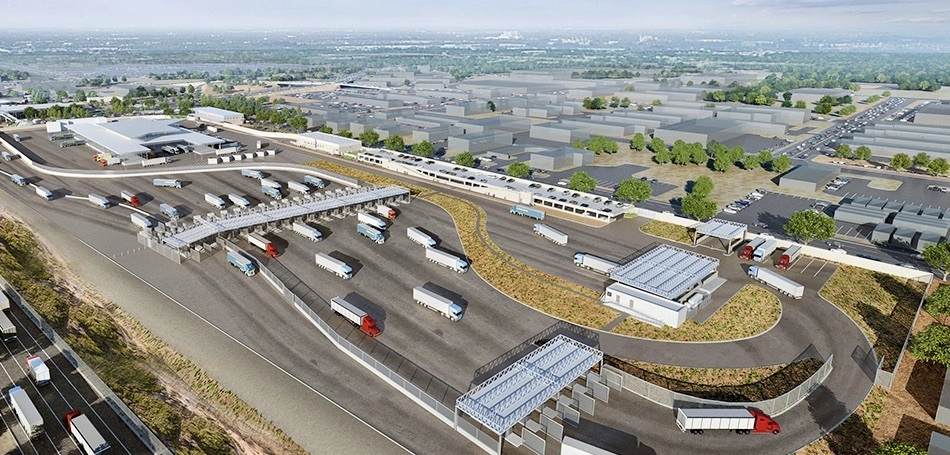
The U.S. government is currently upgrading a number of commercial truck crossings over the international border with Mexico, including the nation’s third busiest at Otay Mesa in Southern California.
“The Department of Transportation has awarded the City of San Diego $24 million to rehabilitate and preserve the 50-year-old Palm Avenue overcrossing bridge in San Diego,” the White House announced on May 15.
It noted that the bridge is a “key connector” for the Otay-Mesa-Nestor community and is “only a few miles” from the U.S.-Mexico border.
According to the U.S. General Services Administration, the Otay Mesa Land Port of Entry is the “busiest” commercial port in California but it cannot support current “northbound commercial traffic.” As a result, GSA is in the process of “modernizing and expanding” the entire existing port.
Trucking offers a key supply chain link between the two countries at San Diego’s Otay Mesa, a point underlined by Transportation Secretary Pete Buttigieg, who said the Biden administration is devoting $150 million to the larger development project, one of many his department is supporting in Southern California.
“Picture one of those trucks that’s going to come through Otay Mesa,” Buttigieg said on a recent visit. “It might head north to a warehouse connected to the Port of LA where we recently announced $20 million to build a new four-lane roadway and bridge—which will save truck drivers a total of almost 2,500 hours every day.”
Buttigieg said the development will include “a new inspection facility for commercial trucks, 10 new lanes for incoming vehicles, state-of-the-art inspection equipment, zero-emissions chargers for staff vehicles and state-of-the-art technology designed to make the entire operation safer and more efficient.”
The announcement is part of an even bigger investment push by the U.S. and Mexico into the 44 international ports of entry along the nearly 2,000 miles of their shared boundary.
At the North American Leaders’ Summit in Mexico City earlier this year, U.S. President Joe Biden and Mexican President Andrés Manuel López Obrador pledged to invigorate the trade sector between the two countries.
Under the 2021 bipartisan infrastructure package, the U.S. has pledged $3.4 billion “to construct, acquire, repair and alter” 26 land ports of entry—20 at the Canadian border and six at the southern border, while Mexico has pledged $1.5 billion from 2022 to 2024.
They have good reason for those pledges: the border between the U.S. and Mexico has a huge impact on the economies of both nations, with more than $53 billion in trade crossing over in just one month, according to a 2022 study by The Atlantic Council’s Adrienne Arsht Latin America Center.
“In July 2022 alone, the United States and Mexico traded over $65 billion in goods, with more than $53 billion crossing the southern border via trucks and trains,” the Atlantic Council report said.
The reference to trains is a timely reminder of growing competition to provide intermodal rail services between the two countries including the recently formed Canadian Pacific Kansas City Southern line as well as a new service offered jointly by CN, Union Pacific Railroad and GMXT.
These new rail connections are an important new link in the supply chain extending between the U.S. and Mexico, and they will greatly enhance intermodal traffic and trade across the common border.
But trucking offers a key link, too, especially over the expanding land crossing at Otay Mesa—as the Biden administration is making abundantly clear.
Photo: Artists’ rendition of new development at Otay Mesa
Photo credit: Morley Construction Company