How Should Essential Workers Empower Themselves in the Workplace?

Essential workers are on the front lines of the pandemic; they’re also the least protected and, often, the lowest paid. A lack of PPE, hazard pay, and paid sick leave for workers in vulnerable sectors, like grocery store, fast food, sanitation, and some other sects of retail, is putting the pressure on employers to act, and the pressure on workers to demand protections.
On this videostream, Voice of B2B Daniel Litwin spoke with Shaun Richman, program director for SUNY Empire State College’s School of Labor Studies. A contributor for In These Times and The American Prospect, Shaun previously spent a decade and a half as a union organizer and representative, and brings his experience to give a worker-focused perspective on…
- Why some businesses are providing protections for workers while others aren’t
- The history of our “broken” labor relations system and the atomization of the workplace
- How a lack of union representation in essential sectors creates an imbalance tilted against workers
- What the long term strategy is for organizing workers in vulnerable sectors
- What small and large businesses can do now to protect their essential workers
For the latest thought leadership, news and event coverage across B2B, be sure to check out our industry pages.

Latest
Episode 5 Promo: There Are No Bad Robots, Only Bad Owners
What really makes or breaks a robotics deployment? Spoiler: it’s not the robot. In the fifth episode of Robot vs. Wild, Vecna Robotics’ Chief Marketing Officer Josh Kivenko and Customer Success Manager Ty LaFramboise reveal why successful automation is less about machines—and more about mindset. From aligning corporate goals with floor-level operations, to helping teams adjust to new…
The DisruptED World of Financial Services with Industry Titan Jerry Wagner
Because this is an era now defined by economic whiplash, algorithmic finance, and global uncertainty, the investment world is increasingly more volatile than before. As inflationary pressures, geopolitical tensions, and trade policies create even further chaos into markets, the stakes for both advisors and investors have heightened. According to data on the Cboe Volatility…
Episode 6 Promo: Behind Every Great Robot Is a Strong Human
In the sixth episode of Robot vs. Wild, Vecna Robotics’ Chief Marketing Officer Josh Kivenko sits down with Nikki Slaughter, Director of Post-Deployment Operations, to shine a light on the real people behind autonomous operations. They explore the critical role of Vecna’s 24/7 remote support team—comparing them to a Formula One pit crew—constantly monitoring…
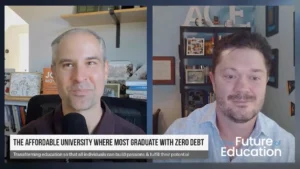
Debt-Free and Results-First: ACE Is Rewriting the Rules of Higher Ed
As student loan debt surpasses $1.7 trillion nationwide, cracks in the traditional higher education model are becoming increasingly difficult to ignore. Meanwhile, the American College of Education is quietly operating with an approach that flies in the face of convention, where 85% of its students graduate debt-free. What does it take to build a…