Focus on Drones in Public Safety at InterDrone 2018
Drones are an exploding marketplace, quickly leaving the niches of military applications and expensive hobbies. One area where drones are really taking off is in safety applications, which was highlighted at InterDrone 2018 in Las Vegas, one of the largest cross-industry drone conferences in the world and the largest commercial drone event in the USA.
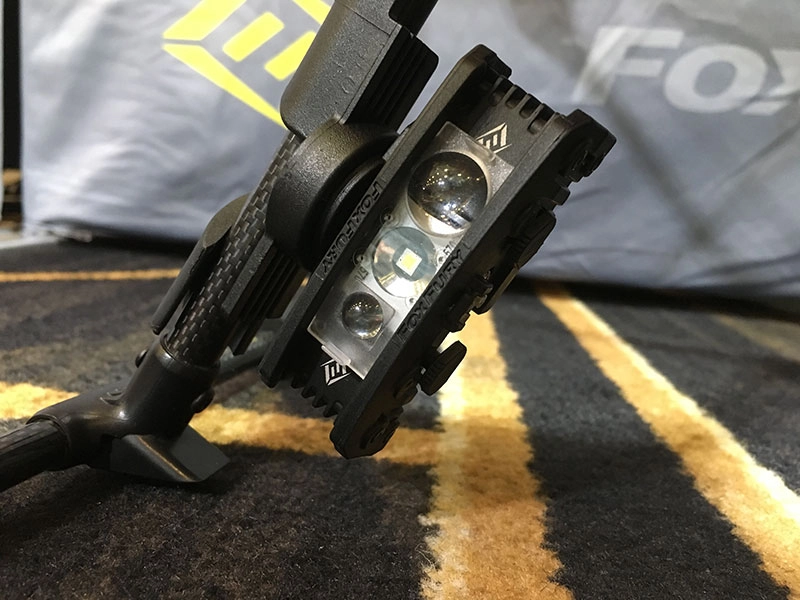
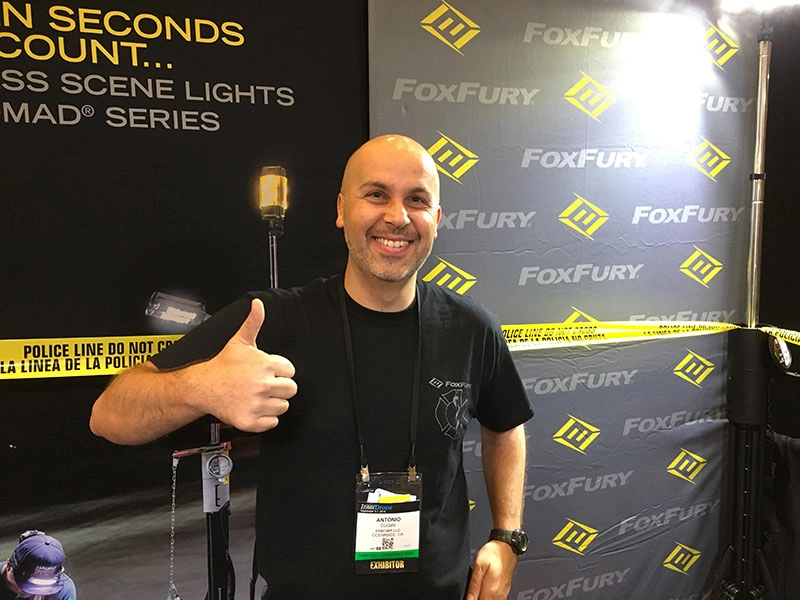
Drones and safety go together in many ways, but in such a new and promising marketplace, there is constant change and innovation. To highlight this, it is essential to see a few examples of how drones are improving public safety. One company, Foxfury Lighting Solutions, manufactures a versatile lighting product called the Rugo, a brilliant 700 lumen light for drones that not only helps to identify drones at night, but also has applications in a wide array of search and rescue projects, infrastructure inspections, and even fugitive apprehension.
Antonio Cugini, the Director of marketing for Foxfury, described some of the creative applications that law enforcement and utility companies have found for the Rugo lights, saying “Drones allow jobs to be done that were otherwise impossible in a way that is faster, more cost-effective, and that hopefully leads to a safer outcome….” He even described an innovative case where law enforcement planned to use the brilliant drone mounted lights to corral and drive a dangerous fugitive hiding in a cornfield back towards the pursuing officers.
The Rugo lights also help make dangerous infrastructure inspections safer. For example, examining the underside of a bridge for cracks and corrosion can now be done by a drone carrying a camera and light. The 700-lumen Rugo can illuminate cracks and structural issues that can’t be seen from the ground, without having to send a person into harm’s way.
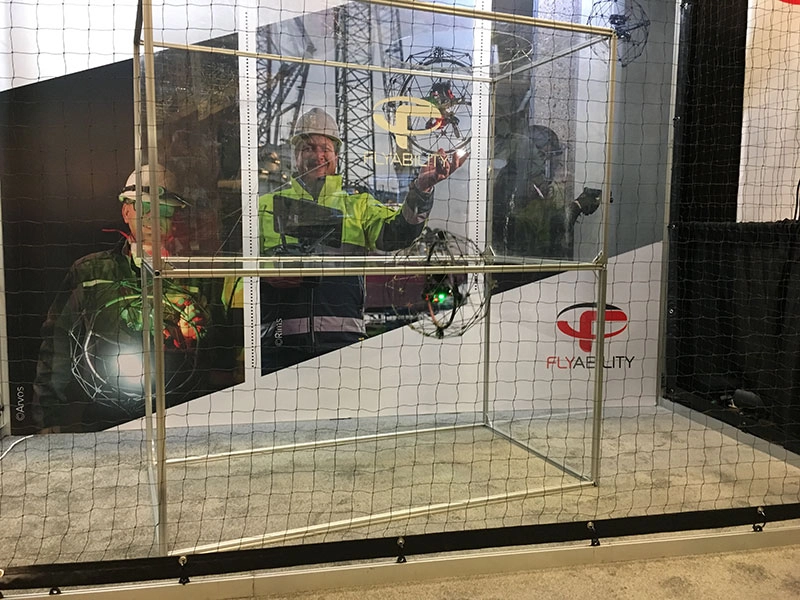
Protecting law enforcement and safety workers is also the goal of Johan Mlouka, business development manager for Flyability, an innovative Swiss drone company that has single-handedly created a new drone market with their Elios Drone. The Elios is the worlds first collision resistant drone specially designed for indoor applications and tight spaces. They market it as “a safe drone for inaccessible places” that can be used to “inspect & explore indoor spaces safely, quickly, & economically.”
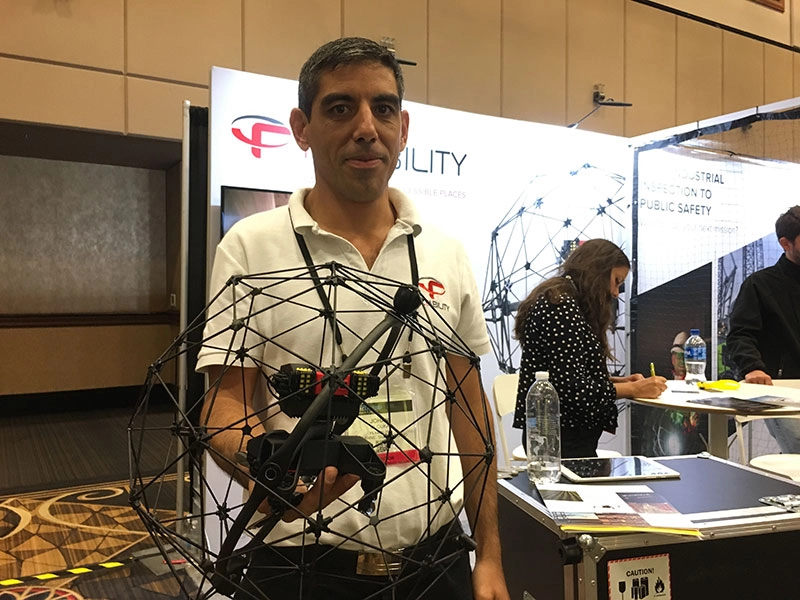
Mlouka said that the drone was already in use with several SWAT teams around Europe, where they have been used to protect officers in hostile shooter situations. He described one case where the drone was used to navigate an area that had a dangerous chemical spill giving the SWAT team situational awareness before they breached the room. This is a new product requiring new designs and new protocols because, as Mlouka described, “flying indoors is completely different from flying outdoors.” There is very little automation and no GPS function requiring the pilot to have a far greater level of situational awareness. With the Elios’s protective cage, suddenly obstacles become part of the flight plan, rather than something to just be avoided. With this innovative protection system, Mlouka was adamant, “that we are at the very beginning of this new market for indoor drones.”
Another area where drones are used for safety applications is, ironically enough, protecting people from drones. With such a new product, the federal flight regulations and local laws have been rather slow to catch up. Drones now pose a threat to public safety, particularly around airports or in public venues like concerts.
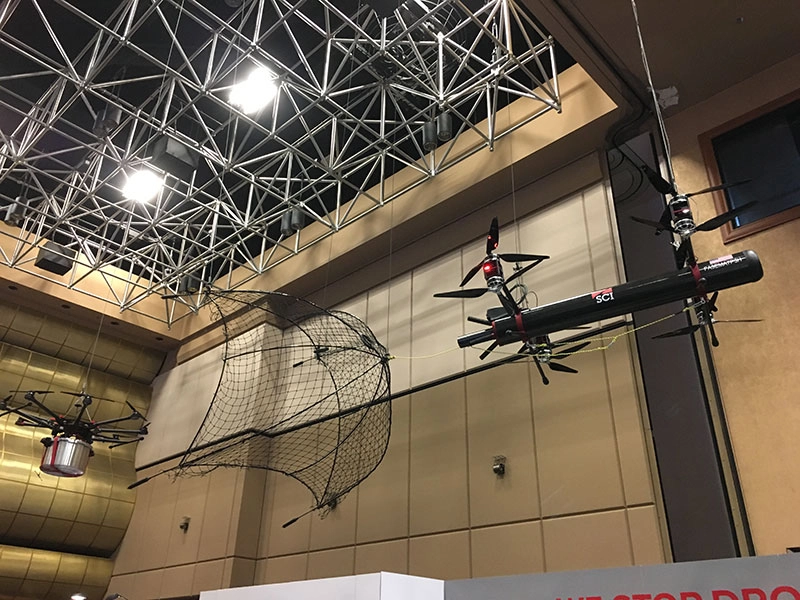
Max Klein, CTO at SCI Technology, also described drones as a new dimension in security threats. Whereas security formerly focused on land-based 2D threats, drones now add a third airborne dimension. In civilian settings, it’s usually not possible to shoot down an unwanted drone, so a safe interdiction system is necessary to protect the public.
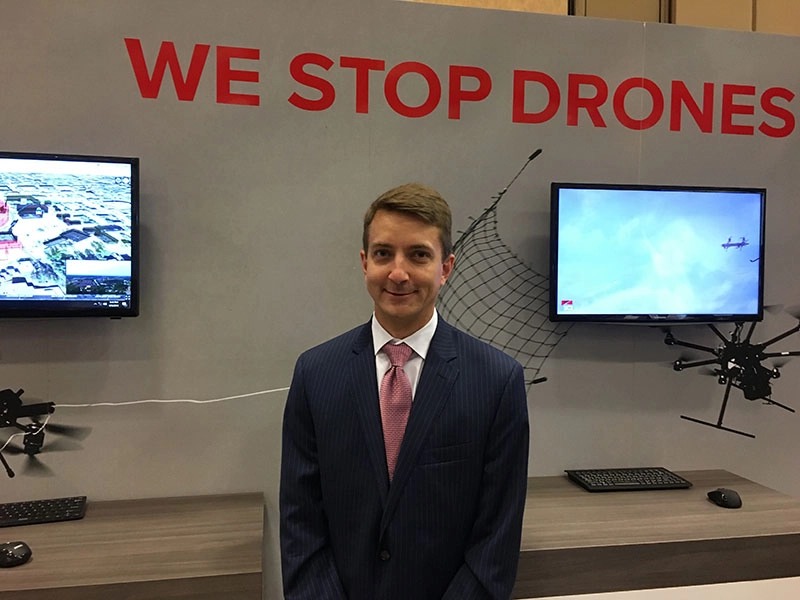
SCI’s Aeroguard is a drone interdiction system that can be launched to capture drones and tow unwanted or illegal drones away from the dangerous area. As Klein described, this fills a serious hole in the market, as there had hitherto been virtually no way to enforce restricted drone airspace.
The Aeroguard can also be applied to protect against corporate espionage and even bootlegging. Klein mentioned events such as the recent assassination attempt via drone of the Venezuelan president, or cases of the illegal recording of outdoor events. Describing a complex regulatory environment, Klein was confident that the counter UAS (unmanned aerial vehicle) market will expand as drones increasingly, and often unwittingly, violate FAA regulations.