Healthcare

At Carevive, we are thrilled to introduce you to the transformative potential of oncology longitudinal patient records, enriched with patient-recorded outcomes. Imagine having a comprehensive view of your patients’ experiences, filling the gaps between visits and infusion sessions, providing invaluable context for more prescriptive and proactive care decisions. Our cutting-edge technology empowers care teams to…
Latest
Carevive
Adding an Additional System: How did the Team Handle Implementing a New system?
In today’s dynamic healthcare landscape, technology has revolutionized patient care. Carevive, a multidisciplinary clinic, exemplifies this by focusing on both physical and mental health. Patients benefit from weekly treatment updates and questionnaires, fostering a sense of security and support. Healthcare providers have embraced the platform, witnessing improved patient outcomes and compliance rates. Carevive’s seamless integration…
Carevive
Understanding Carevive SMART Data™
In a world inundated with vast amounts of healthcare data, making sense of it all can be overwhelming. The questions arise – how do we determine what’s meaningful and actionable amidst the sea of information from various sources? Enter Carevive SMART Data, a game-changer that helps healthcare professionals extract valuable insights from disparate treatment options,…
Carevive
What does Carevive do that my EHR doesn’t and how do I access the data?
In this video, John Elliott from Carevive sheds light on the questions surrounding Carevive’s unique offerings and how they differ from the EMR. Acknowledging the valid question of how Carevive stands apart, John explains that Carevive is complementary to the EMR, often fully embedded within it. What sets Carevive apart is its ability to capture…
Carevive
How Was Your Experience Using Remote Symptom Monitoring?
Using a simple app on her phone, Elva received regular check-ins and support during her cancer treatment. Every Tuesday morning, she would get a text asking about her symptoms, and she found it comforting to share her experiences and receive personalized responses. When she had bad weeks, the doctor would provide recommendations to alleviate her…
Carevive
Understanding Your ROI
John Elliott from Carevive delves into the pressing question of ROI in the evolving landscape of value-based care reimbursement models. As the oncology care model (OCM) transitions into the enhancing oncology model, stakeholders are evaluating the technology, processes, and resources that will support their future endeavors. Carevive proves to be a twofold solution, seamlessly aligning…
Carevive
Patients Want Access to Care: Did Patients Have Challenges Engaging with the Tools?
In a heartwarming testimonial, Elva shares her experience using Carevive’s healthcare app during her cancer treatment. Downloading the app on her phone was simple, and she received regular texts from a supportive caregiver, making her feel fortunate to have a set day for check-ins. The app’s survey allowed her to share her symptoms, and she…
Latest

Pursuing the Impossible: The New Space Race with Firefly Aerospace Co-Founder Eric Salwan
Many companies set out to do something hard. Firefly Aerospace set out to do the impossible. After 10 years and several existential moments, Firefly did what no private company ever had: in 2025, it successfully landed on the Moon. Before Firefly, only countries had ever landed on the Moon—and it took extraordinary national effort…
Tale of Two Interns: What AI Is Really Doing to Entry-Level Work
The narrative around early-career work has become increasingly pessimistic, with headlines pointing to a shrinking pool of entry-level roles, fewer internship opportunities, and AI accelerating both trends. But beneath that narrative, a different tension is emerging—one that’s less about the disappearance of opportunity and more about how it’s being reshaped. Students are using AI…

Power, Cooling, and Risk: What It Takes to Bring a 100MW AI Data Center Online
The industry knows how to build data centers. What it’s still figuring out is how to turn on AI factories at scale. With facilities now crossing 100 megawatts—far beyond the 5 to 10 megawatt norm of traditional builds—operators are no longer just validating equipment. They’re testing whether entire systems—power, cooling, controls, and the teams behind…

Building Beauty for Real Women: Why Brands Must Focus on Longevity, Not Hype
Walk into any beauty aisle—or scroll through your feed for five minutes—and it’s clear the industry is obsessed with what’s new. New formulas, new trends, new “rules.” But for many women, especially those who’ve been using makeup for decades, the question isn’t what’s new—it’s what actually works. And increasingly, the answer isn’t coming from the…
Latest Articles Healthcare

Articles Healthcare
Fixing the Physician Experience: Why Advocacy Is Healthcare’s Next Frontier
Physician burnout has become a defining challenge in healthcare, with research showing that a substantial portion of clinicians—anywhere from roughly a quarter to over half—experience emotional exhaustion, driven more by systemic pressures like administrative burden and reduced autonomy than by individual resilience alone. As healthcare systems face growing staffing shortages and rising patient demand, the…
Understanding Joint Commission 360 Standards: What They Mean for SPD Teams (Part 2)
Healthcare teams today are feeling the pressure to move beyond last-minute compliance and instead build processes that work consistently every day. That shift is especially clear in sterile processing departments (SPDs), where the Joint Commission 360 model is redefining what “survey readiness” really means. With patient safety directly tied to instrument quality—and studies consistently…
Understanding Joint Commission 360 Standards: What They Mean for SPD Teams (Part 1)
For a long time, compliance in healthcare was tied to the survey cycle. Now, that model is shifting. With the introduction of Joint Commission 360, organizations are being asked to demonstrate continuous performance—not just preparedness. As patient safety comes under increasing scrutiny, The Joint Commission is moving toward an approach built on real-time data, traceability,…
Censis’ Final Check Uses Computer Vision to Eliminate Tray Errors Before They Reach the OR
Artificial intelligence used to live in strategy decks and conference keynotes—but now it’s showing up in a very different place: right on the assembly tables where SPD technicians build trays for the next case. And it’s arriving at a time when the pressure on sterile processing has never been higher. As surgical volumes climb and…
Articles Healthcare
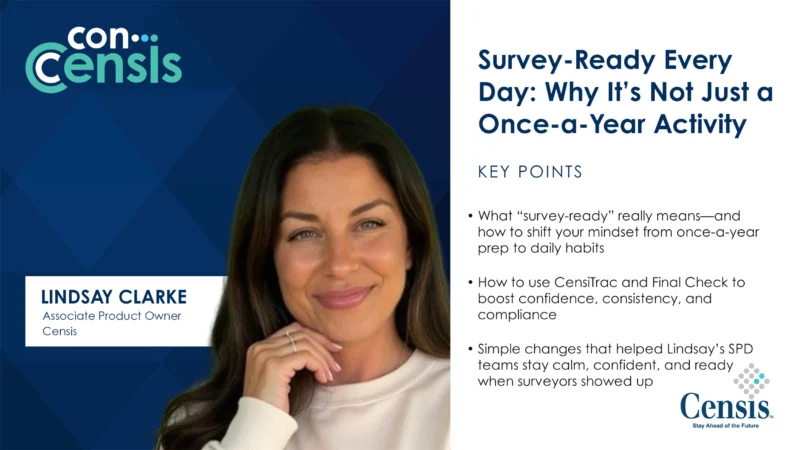
Survey Ready Every Day: Why It’s Not Just a Once-a-Year Activity
Unannounced surveys are no longer the exception in healthcare—they’re the norm. Accrediting bodies increasingly expect sterile processing departments (SPDs) to demonstrate consistent compliance, real-time documentation, and reliable adherence to manufacturers’ instructions for use on any given day, not just during audit season. Joint Commission survey data continue to show that high-level disinfection and sterilization practices…
How Predictive AI Is Helping Hospitals Anticipate Admissions and Optimize Emergency Department Throughput
Emergency departments across the U.S. are under unprecedented strain, with overcrowding, staffing shortages, and inpatient bed constraints converging into a throughput crisis. The American Hospital Association reports that hospital capacity and workforce growth have lagged, intensifying delays from arrival to disposition. At the same time, advances in artificial intelligence are moving from experimental to operational—raising…
Caregiver Engagement Is the Missing Link in Dementia Care: Why Empowering Families Drives Better Outcomes and Lower Costs
Dementia is becoming one of healthcare’s most difficult problems to ignore. As the population ages, more families are finding themselves responsible for loved ones who can no longer manage their own care, communicate symptoms clearly, or navigate the healthcare system. Research shows that people living with dementia are hospitalized far more often than those without it—even…
Getting SPD Teams to the Table: Why Sterile Processing Deserves a Central Role in Surgical Planning and Operations
Sterile Processing Departments (SPDs) remain the backbone of safe surgical care, yet across the country, they’re still routinely left out of early decision-making around products, construction, staffing, and case planning. As hospitals juggle tighter margins, higher patient acuity, and growing procedural demands, the consequences of excluding SPD voices become unmistakably real—showing up in daily…

Articles Healthcare
The Silent Foundation of Patient Safety: Why Water Quality Matters in Sterile Processing
In healthcare, patient safety and operational efficiency often depend on invisible systems working perfectly in the background. One of those systems—water quality—has quietly become a defining factor in sterile processing success. With new standards such as AAMI ST108 setting stricter expectations, hospitals, and SPDs (Sterile Processing Departments) are rethinking how they monitor, manage, and measure…
The SPD Hack Playbook: Streamlining Sterile Processing with Smart Tech and Team Buy-In
Sterile Processing Departments (SPDs) are the unsung backbone of surgical care — ensuring every instrument, tray, and tool is safe, sterile, and ready when needed. Yet, despite their vital role, SPD workflows often rely on manual processes and underrecognized best practices. As healthcare systems push for greater efficiency and staff well-being, SPD managers are turning…
Hot Takes on Rural Healthcare: Lessons from the Frontlines of a System in Decline
Across America, rural hospitals are facing an existential crisis. From physician burnout and recruitment struggles to malpractice insurance woes and shrinking OB units, the challenges facing small health systems are multiplying. According to the National Rural Health Association, roughly 190 rural hospitals have closed down or discontinued inpatient care since 2010 — and many more…
Smarter, Faster, Kinder: How AI Can Help Hospitals Deliver Better Care, All While Keeping Care Human
Artificial intelligence (AI) is no longer just a buzzword in healthcare — it’s becoming a real partner in how providers care for patients and improve everyday experiences. With rising patient expectations, limited resources, and mounting administrative complexity, hospitals and insurers alike are turning to AI to improve efficiency, communication, and satisfaction. In fact, Citi research…
Latest Healthcare Podcasts

Deny This! with Brian McGraw - PayerWatch
From Denial to Access: Rethinking Oncology Care Through AI, Clinical Trials, and Patient-Centered Innovation
The rapid expansion of precision medicine, biologics, and targeted cancer therapies is transforming oncology—but it’s also overwhelming a system not built to keep pace. In the U.S., cancer drugs now account for some of the highest-cost treatments in healthcare, and with that has come a surge in prior authorization requirements and denials. Studies suggest physicians…
Turning Denial Data Into Action: How Healthcare Organizations Can Fight Back Against Payer Denials
Healthcare providers across the U.S. are facing a growing wave of claim denials that is putting pressure on already strained hospital finances. Industry research from the American Hospital Association shows that nearly 15% of medical claims submitted to private payers are initially denied, forcing hospitals and health systems to spend about $19.7 billion annually attempting…
Virtual Physical Therapy and the Changing Landscape of Athlete Care
Virtual care is no longer an experiment—it’s a structural shift in healthcare. Telehealth usage remains significantly higher than pre-2020 levels, and providers across disciplines are rethinking how to deliver higher-quality outcomes without the overhead and insurance constraints of traditional clinics. Meanwhile, recreational and endurance sports participation continues to rise, with millions of Americans registering…
Diagnosing Your Capital Asset Health: Why Asset Visibility Is the New Financial Imperative in Healthcare
Hospitals and surgery centers own millions of dollars in equipment — but owning assets and having actionable visibility into them are two different things. Most systems maintain inventories, yet many struggle with outdated records, fragmented tracking, and limited insight into useful life or service contracts. With nearly half of U.S. hospitals reporting negative operating…

Healthcare
Exploring the Intersection of Board Governance, Community Engagement and Creativity with Ann Margolin
Behind every city vote, hospital budget or zoning decision is a leader navigating tough, often conflicting priorities. Right now, public leaders are operating in an environment of rising healthcare costs, workforce shortages and heightened community expectations—especially within safety-net systems that collectively provide billions in uncompensated care each year. The stakes are real—they affect patients…
AI in Sterile Processing Is Proving Its Value by Acting as a Co-Pilot, Not a Replacement
Sterile processing departments are dealing with persistent operational pressures. Surgical case volumes are rising, instruments are more complex, and staffing shortages remain across many health systems. Accuracy and documentation requirements continue to tighten, leaving little room for error. In busy hospitals, sterile processing teams may handle 10,000 to 30,000 surgical instruments per day, with…
The Legacy of Dr. G. Duncan Finlay – Episode 6
The Rothman Index, developed by Dr. Michael Rothman and his brother Steven, is a pioneering patient acuity score designed to help clinicians recognize patient deterioration earlier and more clearly. Presented as an easily understood, color-coded graph that updates in real time, the Index displays upward and downward trends in patient condition at a glance—transforming…
The Origin Story of the Rothman Index – Episode 5
Hospitals collect enormous amounts of clinical data, yet preventable patient decline remains a persistent challenge. Over the past two decades, hospitals have invested heavily in early warning scores and rapid response infrastructure, but translating data into timely, meaningful action has proven difficult. As clinicians contend with alert fatigue and increasing documentation burden, a more…

Healthcare
My Mother and the Story of the Genesis of the Rothman Index – Episode 4
Healthcare generates enormous volumes of clinical data, yet making sense of that information in real time remains a challenge. Subtle changes in vitals, labs, and nursing assessments often precede serious events, but when that information is fragmented across the medical record, emerging risks can go unnoticed. The central challenge facing hospitals today is not…
Bridging the Gap Between Hospital Discharge and Daily Life: How In-Home Senior Care Improves Outcomes and Reduces Readmissions
As hospitals across the U.S. shorten length of stay and push more recovery into the home, families are increasingly left to manage complex care needs without formal training or support. Roughly one in five patients with chronic conditions like COPD or congestive heart failure is readmitted within 30 days—a cycle that costs the healthcare…
Career Development for Global Pediatric Nurses
The Care Anywhere podcast is spotlighting a new global partnership designed to strengthen pediatric nursing education and recognition worldwide. In this episode, host Lea Sims sits down with leaders from TruMerit and the National Association of Pediatric Nurse Practitioners (NAPNAP) to unpack a new pediatric nursing micro-credential pathway launching in 2026, and why it…
How Simulation-Based Education Is Transforming Healthcare Leadership and Decision-Making Worldwide
As healthcare systems worldwide face rising costs, workforce shortages, and increasing pressure to balance quality with financial sustainability, traditional classroom-based management education is struggling to keep pace. According to the World Economic Forum, healthcare spending now accounts for nearly 10% of global GDP, making leadership decision-making more consequential—and more complex—than ever. At the same…
Latest Videos Healthcare
Care Anywhere Podcast - Season 1
The Tech-Enabled Hospital of the Future: Implications for Care Delivery
Gone are the days when a hospital was simply a place where patients received care. Today’s hospitals are rapidly evolving into highly connected ecosystems powered by advanced technology, networked devices, and real-time data. The modern hospital is no longer confined to physical walls—it’s a dynamic digital environment where data flows seamlessly, AI supports clinical decisions,…
The DAISY Foundation: Impacting Nurse Careers Through Recognition
Recognition is often described as a “nice to have” in healthcare, but on this episode of Care Anywhere, it’s framed as something far more essential. Host Lea Sims sits down with Deb Zimmermann, DNP, RN, NEA-BC, FAAN, Chief Executive Officer of The DAISY Foundation, and Bonnie Barnes, FAAN, co-founder of the organization, to explore…
What the Future Looks Like if We Get It Right
As the Patient Monitoring series concludes, the conversation shifts from today’s challenges to tomorrow’s possibilities. This final episode of the five-part Health and Life Sciences at the Edge series looks ahead to what healthcare could become if patient monitoring gets it right. Intel’s Kaeli Tully is joined by Sudha Yellapantula, Senior Researcher at Medical…
Why We Show Up for Care
Episode 4 of The Future of Patient Monitoring takes a step back from infrastructure and innovation to explore something deeper: the people behind the technology—and what they’ve learned through years of building smarter systems. Part of the Health and Life Sciences at the Edge podcast series, this conversation is led by Intel’s Kaeli Tully,…
Care Anywhere Podcast - Season 1
Career Development for Global Pediatric Nurses
The Care Anywhere podcast is spotlighting a new global partnership designed to strengthen pediatric nursing education and recognition worldwide. In this episode, host Lea Sims sits down with leaders from TruMerit and the National Association of Pediatric Nurse Practitioners (NAPNAP) to unpack a new pediatric nursing micro-credential pathway launching in 2026, and why it…
Expanding Monitoring in Acute Care and Beyond
As hospitals look beyond the ICU to improve outcomes across the entire continuum of care, a key question emerges: how do you expand patient monitoring without overwhelming clinicians with more alarms, more noise, and more work? This episode—part three of a five-part Health and Life Sciences at the Edge series exploring The Future of…
The Hidden Roadblocks to Smarter Hospitals
As hospitals look to improve outcomes with faster, more informed decisions, infrastructure limitations remain a major hurdle. This episode—part two of a five-part Health and Life Sciences at the Edge series exploring The Future of Patient Monitoring—dives into what’s holding back smarter, more connected care. Intel’s Andrew Lamkin, AI Solutions Architect, and Bikram Day,…
ROI Case Study
Denials are no longer a slow leak in the revenue cycle—they’re a fast-moving, rule-shifting game controlled by payers, and hospitals that don’t model denial patterns in real time end up budgeting around losses they could have prevented. PayerWatch’s four-digit, client-verified ROI in 2024 shows what happens when a hospital stops reacting claim by…

Healthcare
Clip 2 – Fighting for Coverage: One Patient’s Story
Health insurers love to advertise themselves as guardians of care, but the real story often begins when a patient’s life no longer fits neatly into a spreadsheet. In oncology especially, “coverage” isn’t a bureaucratic checkbox—it’s the fragile bridge between a treatment that finally works and a relapse that can undo years of grit…
Clip 1 – Fighting for Coverage: One Patient’s Story
In “Fighting for Coverage,” a patient describes a double war: the physical fight to stay alive and the bureaucratic fight to prove to an insurer that her life is worth the cost. Her account spotlights a core tension in the U.S. system—coverage decisions are increasingly shaped by prior authorizations and desk-based reviewers who…
The Sustainability of the Healthcare System
The sustainability of the healthcare system won’t be secured by another round of cost-cutting or clever benefit design alone, but by a hard cultural pivot toward alignment: payers, providers, employers, and patient advocates pulling on the same rope instead of grading each other on different exams. Right now we’ve built a maze that…
Allow Doctors to Provide Care Without Making Patients Fight the Insurance System
Patients shouldn’t have to become their own case managers just to access a hip replacement, transplant, or any other life-changing procedure; the moment they’re pushed into a paperwork fight, the system has already shifted its burden onto the sick. In a functional healthcare model, clinicians and their teams handle the insurer negotiations behind…