Self-Learning Robots Find a Better Way to Dry

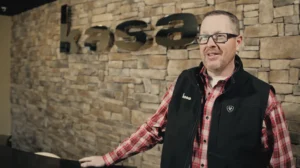
Derek DeGeest, President of DeGeest Corporation & LestaUSA, and Brad Ruppert, Engineering Manager and Application Specialist at DeGeest Corporation & LestaUSA, have a passion for new technology.
When they can apply that to the manufacturing finishing process, it gives them a level of excitement that is contagious. They were excited to announce a new product to their arsenal of efficiency-minded, process-improvement robots. This latest technology isn’t just new to North America, but the world. Introducing Lesta’s new self-learning suction blow off robots.
As DeGeest Corporation was putting in their self-learning fully automated finishing system, they identified a problem – how were intricate parts dried after pre-treatment stage?
These parts have lots of areas where water gets trapped. Traditional methods of manually blowing off parts and evaporating standing water in the dry off oven were not acceptable for DeGeest’s team. An idea came up to use Lesta robot technology to complete the drying task, and that’s when Ruppert and the rest of the DeGeest engineering team went to work.
“This is a problem that is dealt with in every system in every way it’s set up,” Ruppert said. “If you’re applying a coating and you’re using a wash or a wand wash to clean that part, there’s always residual left. In many of the applications in my previous positions, you generally had a guy standing there with ladders and blow off. You try to task them with a couple of other things, because it is very monotonous.”
The easiest way around doing this method is to turn up your dry off oven to evaporate the standing water, but the temperature required to heat these parts and the time it takes to dry them make it cost-prohibitive. With Ruppert’s team’s reengineered robot designed to handle the dry off process, DeGeest created a fully automated finishing process.
One of the main benefits of these suction blow-off robots is their ability to make programs in seconds that can automatically eliminate standing water on all parts before entering the dry off oven. This eliminates a monotonous manual operation and allows a team member to work on other more important tasks for their system. It also allows the ovens to now run at up to 30% lower temperatures and in less time. Not only does this speed up the overall process, it also reduces the overhead cost of running the dry off oven.
Follow us on social media for the latest updates in B2B!
Twitter – @MarketScale
Facebook – facebook.com/marketscale
LinkedIn – linkedin.com/company/marketscale