Backstage Pass: RFID is Transforming Asset Tracking in AV

In the past, event technology specialists at AV companies had to manually scan each item of gear making its way out the warehouse. Some still manually scan to this day; it’s an antiquated system that takes days, or even weeks, and is prone to human error. But as Alford Media can attest to, that has changed with RFID asset tracking technology.
On this episode of Backstage Pass, Alford Media’s vice president of business operations Melanie Reed, and director of operations Billy King, share how Alford is leading the charge in asset tracking for AV gear, and how RFID revolutionized logistics at the company.
Reed and King each have twenty years of experience at Alford Media and know the disadvantages of manually scanning barcodes for millions of dollars worth of equipment. When humans make a mistake, like misplacing essential gear, it can cause headaches at the show site and stop expensive productions in their tracks.
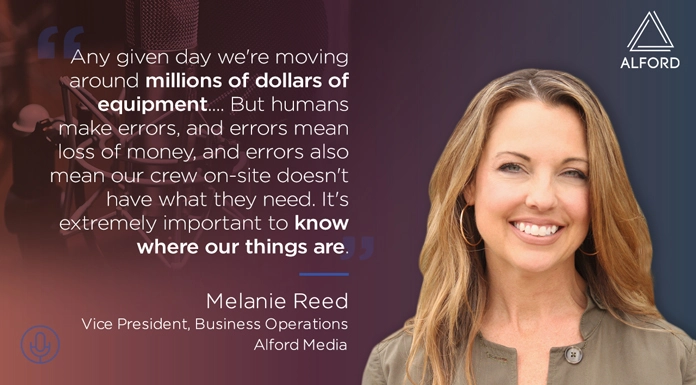 To optimize its processes, the company started looking into RFID tracking solutions in 2005, King explained, but the technology just wasn’t ready. As advancements were made, the company went back and started developing a custom solution that would allow scanners to instantly read and log tagged items as they were loaded on the truck.
As Reed recalled, perfecting the technology wasn’t easy and took countless meetings, experiments, and trial-and-error. But now their RFID system provides real-time tracking of gear – no manual barcode scanning required. It dramatically speeds logistics and removes human error so that crews can help put on the best event possible.
Reed said all the hard work developing the software was worth it and Alford’s culture of integrity and openness is the reason the company is happy to share what they’ve learned with other organizations looking to set up an RFID tracking infrastructure of their own.
For the latest news, videos, and podcasts in the Pro AV Industry, be sure to subscribe to our industry publication. A new episode of the Pro AV Show drops every Thursday.
Follow us on social media for the latest updates in B2B!
Twitter – @ProAVMKSL
Facebook – facebook.com/marketscale
LinkedIn – linkedin.com/company/marketscale