Video – Hexagon Global

As the Patient Monitoring series concludes, the conversation shifts from today’s challenges to tomorrow’s possibilities. This final episode of the five-part Health and Life Sciences at the Edge series looks ahead to what healthcare could become if patient monitoring gets it right. Intel’s Kaeli Tully is joined by Sudha Yellapantula, Senior Researcher at Medical…
Latest
Health and Life Sciences at the Edge
Why We Show Up for Care
Episode 4 of The Future of Patient Monitoring takes a step back from infrastructure and innovation to explore something deeper: the people behind the technology—and what they’ve learned through years of building smarter systems. Part of the Health and Life Sciences at the Edge podcast series, this conversation is led by Intel’s Kaeli Tully,…
Health and Life Sciences at the Edge
Expanding Monitoring in Acute Care and Beyond
As hospitals look beyond the ICU to improve outcomes across the entire continuum of care, a key question emerges: how do you expand patient monitoring without overwhelming clinicians with more alarms, more noise, and more work? This episode—part three of a five-part Health and Life Sciences at the Edge series exploring The Future of…
Health and Life Sciences at the Edge
The Hidden Roadblocks to Smarter Hospitals
As hospitals look to improve outcomes with faster, more informed decisions, infrastructure limitations remain a major hurdle. This episode—part two of a five-part Health and Life Sciences at the Edge series exploring The Future of Patient Monitoring—dives into what’s holding back smarter, more connected care. Intel’s Andrew Lamkin, AI Solutions Architect, and Bikram Day,…
Health and Life Sciences at the Edge
Laying Out the Landscape in Today’s Patient Monitoring
More and more hospital environments rely on continuous, high-quality data to support faster clinical decisions, but much of today’s patient monitoring still varies widely by unit, device, and workflow. This episode kicks off a five-part Health and Life Sciences at the Edge series exploring The Future of Patient Monitoring. Intel’s Kaeli Tully, Solutions Engineer…
Health and Life Sciences at the Edge
Scaling Clinical Diagnostic Testing to the Masses (Part 2)
The rising cost of health care has hit Americans differently depending on their economic status. There is no shortage of news stories covering the reality of those with higher incomes having higher life expectancies than those in lower financial brackets. Healthcare services such as clinical diagnostic testing may be out of reach for those who…
Health and Life Sciences at the Edge
Scaling Clinical Diagnostic Testing to the Masses (Part 1)
The rising cost of health care has hit Americans differently depending on their economic status. There is no shortage of news stories covering the reality of those with higher incomes having higher life expectancies than those in lower financial brackets. Healthcare services such as clinical diagnostic testing may be out of reach for those who…
Latest
Stop Chasing Titles, Build a Career That Matters – From a CAO
Career advice in finance and accounting often centers around promotions, titles, and compensation. But in an era where professionals frequently change jobs every few years—the average American worker now stays in a role less than four years—industries are facing growing talent shortages and reevaluating what long-term career success looks like. The question many professionals are…

A CEO’s Blueprint for Career Success: Leading with Love to Drive Performance and Culture
Leadership right now feels heavier than it did just a few years ago. Teams are stretched, expectations are high, and many employees are quietly disengaged. In fact, Gallup’s 2025 U.S. data shows that only about 31% of employees are actively engaged at work, leaving the majority feeling disconnected or indifferent. For CEOs and senior…
The Degree That Pays You Back: How Employer-Sponsored Apprenticeships Are Rewriting Higher Ed
Higher education is under pressure. Over the past few years, public confidence in the value of a four-year degree has declined significantly, with fewer Americans expressing a strong belief that traditional higher education delivers a worthwhile return on investment. At the same time, employers consistently report that graduates lack job-ready skills—particularly the “durable skills”…

Turning Denial Data Into Action: How Healthcare Organizations Can Fight Back Against Payer Denials
Healthcare providers across the U.S. are facing a growing wave of claim denials that is putting pressure on already strained hospital finances. Industry research from the American Hospital Association shows that nearly 15% of medical claims submitted to private payers are initially denied, forcing hospitals and health systems to spend about $19.7 billion annually attempting…
Latest Health and Life Sciences at the Edge
Health and Life Sciences at the Edge
What the Future Looks Like if We Get It Right
As the Patient Monitoring series concludes, the conversation shifts from today’s challenges to tomorrow’s possibilities. This final episode of the five-part Health and Life Sciences at the Edge series looks ahead to what healthcare could become if patient monitoring gets it right. Intel’s Kaeli Tully is joined by Sudha Yellapantula, Senior Researcher at Medical…
Why We Show Up for Care
Episode 4 of The Future of Patient Monitoring takes a step back from infrastructure and innovation to explore something deeper: the people behind the technology—and what they’ve learned through years of building smarter systems. Part of the Health and Life Sciences at the Edge podcast series, this conversation is led by Intel’s Kaeli Tully,…
Expanding Monitoring in Acute Care and Beyond
As hospitals look beyond the ICU to improve outcomes across the entire continuum of care, a key question emerges: how do you expand patient monitoring without overwhelming clinicians with more alarms, more noise, and more work? This episode—part three of a five-part Health and Life Sciences at the Edge series exploring The Future of…
The Hidden Roadblocks to Smarter Hospitals
As hospitals look to improve outcomes with faster, more informed decisions, infrastructure limitations remain a major hurdle. This episode—part two of a five-part Health and Life Sciences at the Edge series exploring The Future of Patient Monitoring—dives into what’s holding back smarter, more connected care. Intel’s Andrew Lamkin, AI Solutions Architect, and Bikram Day,…
Health and Life Sciences at the Edge
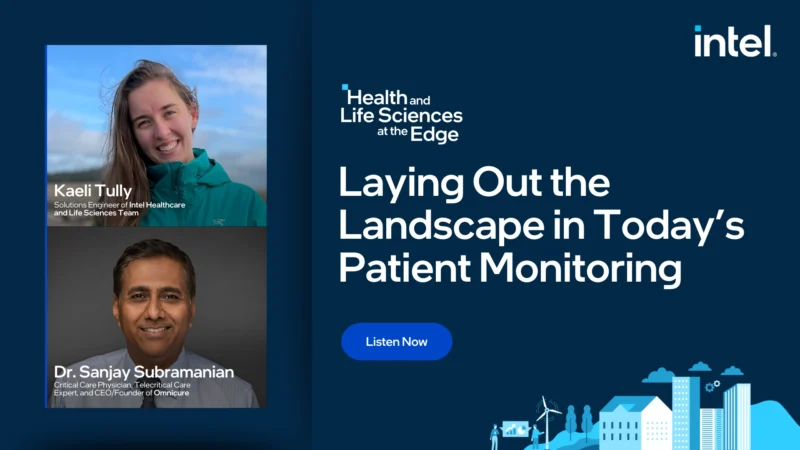
Laying Out the Landscape in Today’s Patient Monitoring
More and more hospital environments rely on continuous, high-quality data to support faster clinical decisions, but much of today’s patient monitoring still varies widely by unit, device, and workflow. This episode kicks off a five-part Health and Life Sciences at the Edge series exploring The Future of Patient Monitoring. Intel’s Kaeli Tully, Solutions Engineer…
Scaling Clinical Diagnostic Testing to the Masses (Part 2)
The rising cost of health care has hit Americans differently depending on their economic status. There is no shortage of news stories covering the reality of those with higher incomes having higher life expectancies than those in lower financial brackets. Healthcare services such as clinical diagnostic testing may be out of reach for those who…
Scaling Clinical Diagnostic Testing to the Masses (Part 1)
The rising cost of health care has hit Americans differently depending on their economic status. There is no shortage of news stories covering the reality of those with higher incomes having higher life expectancies than those in lower financial brackets. Healthcare services such as clinical diagnostic testing may be out of reach for those who…
Transforming Hospital Workflows with Network Operations Centers (NOCs) and Coordinated Clinical Care
The nucleus of a hospital is increasingly becoming its network operations center. If the system isn’t connected, communication breaks down. The evolution of network operations centers in healthcare and how to build an effective one drives the conversation on this episode of Health and Life Sciences at the Edge by Intel. Intel’s Global Head of…
Health and Life Sciences at the Edge
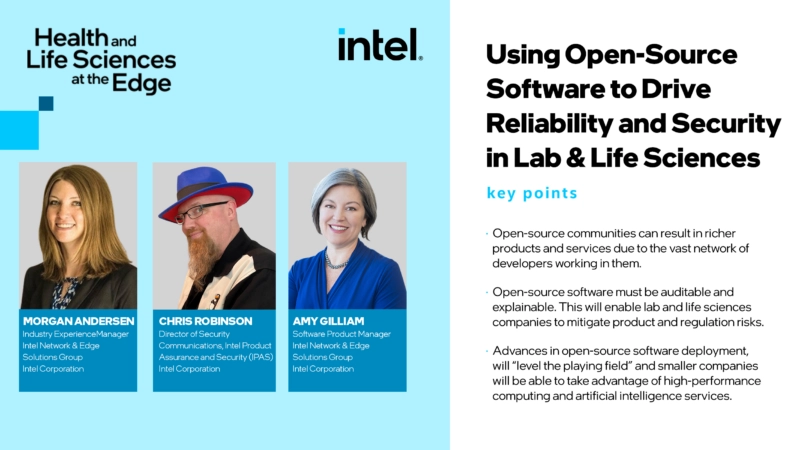
Using Open-Source Software to Drive Reliability and Security in Lab & Life Sciences
Open-Source software’s flexibility through its distribution with the source code gives programmers the power to modify and distribute with its original rights. That versatility allows many technological innovations within the Health and Life Science space. Intel partners with Health and Life Science organizations on a wide range of solutions, and open-source is critical to…
Creating Value for Clinicians and Patients Through Next-Gen Digital Workflows
Next-generation digital workflows are at the forefront of advancing how clinicians deliver healthcare. Intel partners with custom EMR workflow providers such as SaVia Health to improve those solutions and make new ones possible. Intel Head of Global Health Solutions Alex Flores recently sat down with SaVia Health CEO and Chairman William Caldwell to pull…
How Augmented Reality and Immersive Technologies Can Improve Patient Outcomes
On this episode of Intel’s Health and Life Sciences at the Edge, host Gabrielle Bejarano chats with Providence Health System VP and Chief Talent Officer Darci Hall and Intel Health Account Executive Jeffrey Berghammer about the opportunities for augmented reality and immersive technologies to support digital transformation in healthcare. When the onset…
How Cloud to Edge Technology Helps Handle the Immense Amount of Data Generated By Practitioners
Healthcare organizations generate massive amounts of data, so much so that the challenge becomes how and where to move it and store it. Health and Life Science at the Edge host, Gabrielle Bejarano, spoke with Zettar’s Chin Fang and Intel’s Michael McManus for a peek inside the technology solutions Zettar and Intel are partnering…